Dental Hygiene Pathway Certificate
| Type | Part Time Full Time |
|---|---|
| Length | 1 year |
| Campus | Prince George Quesnel |
| Delivery | In Class |
| Fees* |
Check Fee Schedule
*All fees are an estimate. |
| Starting Semesters | Fall 2027 |
Overview
Thinking of becoming a dental hygienist?
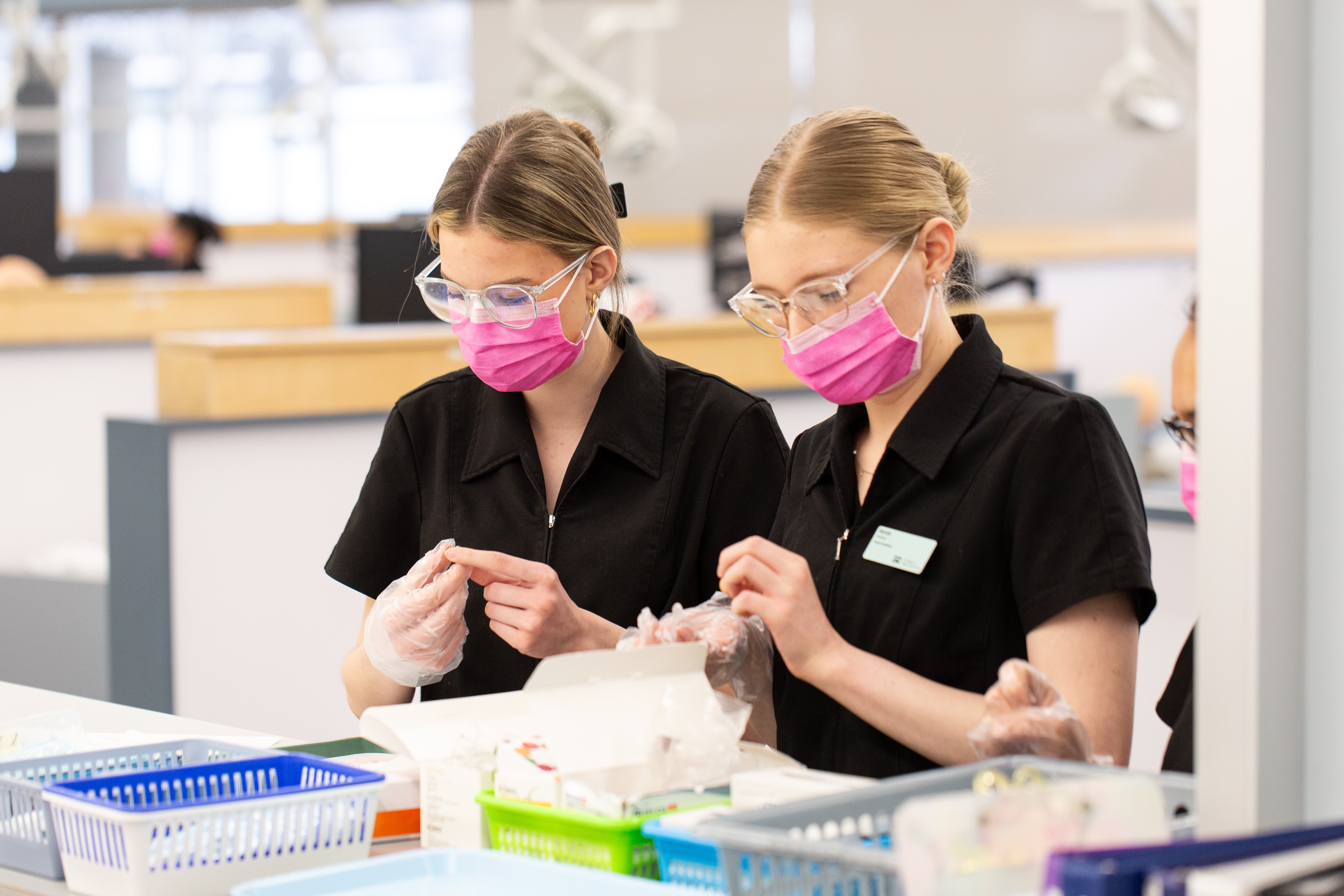
Get your first year of college behind you with the dental hygiene pathway certificate program. With this program, you’ll be meeting your course admission requirements for entry into a Dental Hygiene Diploma
After receiving your Dental Hygiene Pathways Certificate, you have the option to apply to a Dental Hygiene program across BC, or transfer credits to a related program that better suits your future goals.
Careers
Our graduates are career-ready and are highly employable. CNC graduates are highly sought after. Working as a Dental Hygienist, you will practice in a variety of settings, such as:
- Private dental practices
- Independent dental hygiene practice
- Public health facilities, hospitals
- Long term care facilities
- Educational institutions
- Dental research industry
Courses
Core Courses
Typical Offerings
| Timing | All Terms, Every Year |
|---|---|
| Locations | Burns Lake, Mackenzie, Vanderhoof, Prince George, Quesnel |
Description
This general survey course includes topics such as a brief history of psychology, basic research methodology, biological psychology, sensation, perception, consciousness, learning, memory, language and thought.Typical Offerings
| Timing | Fall/Spring Only, Every Year |
|---|---|
| Locations | Burns Lake, Mackenzie, Vanderhoof, Prince George, Quesnel |
| Requisites |
|
Description
This course is a continuation of PSYC 101. Topics include developmental psychology, intelligence and intelligence testing, personality and personality assessment, motivation, emotion, stress and health, social psychology, an introduction to psychological disorders and their treatment.Typical Offerings
| Timing | All Terms, Every Year |
|---|---|
| Locations | Prince George, Quesnel |
Description
A study of grammar, composition, and style. A vigorous program of essay-writing plus a variety of writing assignments or exercises dealing with specific problems in essay-writing. Strongly recommended for students who wish to improve their writing skills.Typical Offerings
| Timing | All Terms, Every Year |
|---|---|
| Locations | Prince George, Quesnel |
| Requisites |
|
Description
This course is the first half of a comprehensive survey of the structures and functions of the human organ systems. Lecture topics include cellular physiology, histology, and studies of the integumentary, skeletal, nervous, and endocrine systems. An extensive laboratory component is included. This course is appropriate for students who intend to enter Health Sciences programs.Typical Offerings
| Timing | All Terms, Every Year |
|---|---|
| Locations | Prince George, Quesnel |
| Requisites |
|
Description
This course is a continuation of Human Anatomy and Physiology I. It is designed to cover the anatomy and physiology of the muscular, cardiovascular, lymphatic, respiratory, digestive, urinary, and reproductive systems. The emphasis is on the importance of homeostasis and how it is maintained by the concerted functioning of body systems. A laboratory component is included.Math Choice
Typical Offerings
| Timing | All Terms, Every Year |
|---|---|
| Locations | Prince George, Quesnel |
| Requisites |
|
Description
This course is an introduction to the theory, techniques and applications of elementary statistics and statistical methodology. It is intended primarily for students majoring in health sciences, business, and liberal arts programs. Topics include descriptive statistics, sampling, elementary probability, probability distributions, statistical inference, correlation, linear regression and analysis of variance. Applications to a wide variety of real-world problems are emphasized.Typical Offerings
| Timing | Fall/Spring Only, Every Year |
|---|---|
| Locations | Prince George, Quesnel |
| Requisites |
|
Description
This course introduces students to the concepts and applications of statistics in the social sciences. The focus will be on the analysis and interpretation of data using descriptive and inferential statistics. In the laboratory, students will gain experience with computerized data analysis.ENGL choice
Elective Arts, Sciences that transfer to SFU UBC UNBC UVIC
Chemistry Choice
Typical Offerings
| Timing | Fall Only, Every Year |
|---|---|
| Locations | Prince George, Quesnel |
| Requisites |
|
Description
This course is designed for students who have taken a Chemistry 12 equivalent course within the past 2 years. Topics covered include the electronic structure of atoms, trends of the periodic table, modern bonding theories, intermolecular forces and organic chemistry. A strong understanding of stoichiometry is recommended. Students who take this course cannot take CHEM 113 for additional credit.Typical Offerings
| Timing | Spring Only, Every Year |
|---|---|
| Locations | Prince George, Quesnel |
| Requisites |
|
Description
Together with CHEM 111, this course provides credit for first-year university chemistry. Topics covered include thermochemistry and chemical thermodynamics, properties of solutions, solution stoichiometry and aqueous equilibria, chemical equilibrium, acid-base equilibrium, electrochemistry and reaction kinetics. Students who take this course cannot take CHEM 114 for additional credit.Typical Offerings
| Timing | Fall/Spring Only, Every Year |
|---|---|
| Locations | Prince George, Quesnel |
| Requisites |
|
Description
This course is primarily intended for students without a Chemistry 12 equivalent prerequisite. Topics covered include stoichiometry, solutions, the electronic structure of atoms, trends of the periodic table, modern bonding theories, intermolecular forces and organic chemistry. Students who take this course cannot take CHEM 111 for additional credit.Typical Offerings
| Timing | Fall/Spring Only, Every Year |
|---|---|
| Locations | Prince George, Quesnel |
| Requisites |
|
Description
This course, together with CHEM 113, provides credit for first-year university chemistry. Topics covered include thermochemistry and chemical thermodynamics, reaction kinetics, properties of solutions, solution stoichiometry and aqueous equilibria, chemical equilibrium, acid-base equilibrium, and electrochemistry. Students who take this course cannot take CHEM 112 for additional credit.Entry Requirements
Fall 2027 Intake and Onwards
For applications to the Fall 2027 intake (September start), you must meet the following requirements:
- The following courses or their equivalent, with a minimum grade of "C":
- Anatomy and Physiology 12, or
- Chemistry 11, or
- Foundations of Math 11, or
Program Specific Recommendations
The following courses or their equivalents:
- Chemistry 12, or
- Pre-Calculus 12, or
Need help meeting these requirements? Check out our options.
| Type | Campus | Starts | Status |
|---|---|---|---|
|
|
|
Open for Applications |
|
|
|
Open for Applications |
Invest in your future
Student fees vary by campus. Check the for more details.
Supplies for this program can be purchased from the bookstore.