Dental Hygiene Diploma
| Type | Full Time |
|---|---|
| Length | 2 years |
| Campus | Prince George |
| Delivery | In Class |
| Fees* |
$27,138.47
*All fees are an estimate. |
| Starting Semesters | Fall 2026 |
Applications for the 2027 Fall Intake open in October 2026
Overview
Are you looking for a fast-growing and rewarding profession within the health sector? Become a Registered Dental Hygienist by enrolling in this two-year diploma! Dental hygiene is the 6th largest regulated heath profession in Canada with over 31,170 practitioners. Registered Dental Hygienists are highly educated, licensed and regulated healthcare professionals whose education and practice focus on the prevention of oral disease and the promotion of overall health and well-being. Dental Hygienists can work independent of or alongside a Dentist and are an important part of the health care team.
As a Dental Hygienist, you will have the flexibility to work full or part time in a variety of settings. Dental Hygienists provide services and programs to people of all ages, addressing issues related to oral health. Responsibilities of the dental hygienist include:
- Medical history taking
- Patient assessment
- Identification of patient health status and needs
- Planning for patient care
- Delivering education and patient services
- Assessing the outcomes of care provided
- Performing routine head and neck examinations
- Dental and periodontal examinations
- Exposing dental images
- Oral hygiene education
- Administration of local anesthetic
- Debridement of teeth
- Preventative fluoride applications.
To be successful as a dental hygienist student and professional, the student requires:
- A caring nature and interest in the well-being of others
- Excellent interpersonal skills
- Excellent time management skills and study habits
- Good eyesight, hearing, and hand-eye coordination. It is strongly recommended that students have an eye examination and obtain corrective eyewear if needed.
- Ability to accurately follow verbal and written directions
- Ability to manage a fast-paced, demanding, and stressful work environment
- Computer literacy especially experience with word processing and internet
- Ability to model the same standard of oral health that they encourage in their patients
Careers
Our graduates are career-ready and are highly employable. CNC graduates are highly sought after and benefit from good working conditions and a competitive salary. Working as a Dental Hygienist, you will practice in a variety of settings, such as:
- Private dental practices
- Independent dental hygiene practice
- Public health facilities, hospitals
- Long term care facilities
- Educational institutions
- Dental research industry
Accreditation
The Dental Hygiene program is accredited by the Commission on Dental Accreditation of Canada. When you graduate, you’re eligible to write Canadian and American national certification exams. Our graduates consistently attain a very high pass rate on their board exams.
New graduates seeking licensure with the Alberta College of Dental Hygienists (ACDH) should be aware that their process for licensure is different from other regulatory colleges. The ACDH requires a substantial equivalency (SE) process by all dental hygiene programs across Canada, including the College of New Caledonia's (CNC), at a minimum of every three years. Students intending to register in Alberta should be aware it is their responsibility to ensure SE with CNC is current and as needed, work with the appropriate channels to initiate the process. As an alternative to the substantial equivalency process, new graduates can register and complete 600 hours of practice in another Canadian jurisdiction. Upon completion of the 600 practice hours, registrants may then apply for registration with the ACDH. For more information regarding this process see the ACDH registration link.
Learning experience at CNC
At CNC, we pride ourselves in having an outstanding reputation for educating skilled dental professionals.
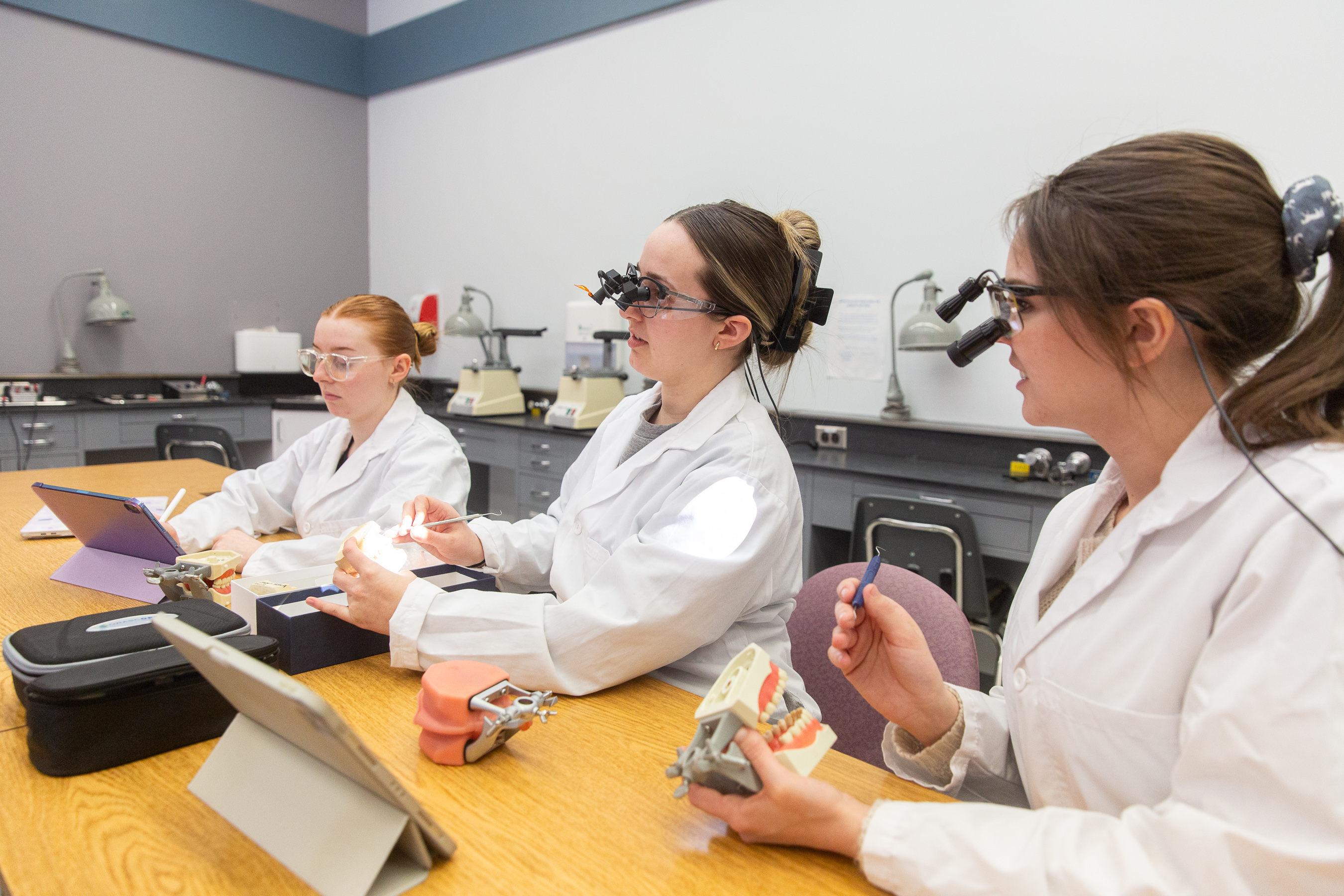
The CNC dental hygiene program offers small class sizes and a 1:6 ratio of faculty to students in the clinical setting. Our clinic is equipped with 20 dental operatories and 4 radiography rooms with computerized dental stations and digital radiography and record keeping abilities. Student activity involved in our dental clinic providing patient-centered oral healthcare services.
Our dental hygiene curriculum incorporates community-based learning experiences. CNC Dental Studies partners with local organizations to deliver dental hygiene services to elementary school–aged children, giving students meaningful, hands-on exposure to community care. Through collaborations with organizations such as Northern Health Authority and the Emergency Dental Outreach Clinic, students engage in experiential learning while providing education and oral health services to diverse community groups. In addition, students complete a complex care rotations with residents residing in long-term care facilities.
Courses
The Dental Hygiene program prepares you to practice as licensed, regulated, health care professional team members. Dental hygienists are preventative oral health care providers, providing specialized services in oral health education, clinical therapy, and health promotion. Dental hygienists practice in a wide variety of settings, including private clinics and community health settings.
Required courses
Typical Offerings
| Timing | Fall Only, Every Year |
|---|---|
| Locations | Prince George |
| Requisites |
|
Description
A pre-clinical and seminar lab introducing basic principles of dental hygiene care. Emphasis is on initial fundamental skills associated with dental hygiene practice and the basic assessment, dental hygiene diagnosis, planning, implementation, and evaluation (ADPIE) process. This course will also introduce the application of radiographic techniques. Clinic sessions will be used to learn and practice clinical procedures required prior to treating patients. Student activities will include working on manikins, on each other, and with simulation exercises.Typical Offerings
| Timing | Fall Only, Every Year |
|---|---|
| Locations | Prince George |
| Requisites |
|
Description
A theoretical course introducing basic principles of dental hygiene care. Emphasis is placed upon following the dental hygiene process of care using ADPIE: assessment, dental hygiene diagnosis, planning, implementation, and evaluation. Course content and activities are closely associated with clinical activities to enhance the student's critical thinking and basic clinical skills ability.Typical Offerings
| Timing | Fall Only, Every Year |
|---|---|
| Locations | Prince George |
| Requisites |
|
Description
This course studies oral anatomic landmarks and establishes an understanding of the relationship between structure and function. Tooth morphology and identification, features of crown and root anatomy, eruption and occlusion are discussed with an emphasis on how they relate to dental hygiene care.Typical Offerings
| Timing | Fall Only, Every Year |
|---|---|
| Locations | Prince George |
| Requisites |
|
Description
This course introduces dental hygiene students to oral microbiology. The basic principles of microbiology are presented in this course, with an emphasis on the relevance of these principles to human oral health. Diseases of microbial origin that concern the dental hygienist are presented to illustrate the principles of pathogenesis, host-parasite interaction, and modes of transmission. Infection control in a dental environment is emphasized.Typical Offerings
| Timing | Spring Only, Every Year |
|---|---|
| Locations | Prince George |
| Requisites |
|
Description
This course is designed to introduce the student to the profession of Dental Hygiene. A historical perspective of dental hygiene is provided. The concepts of being a member of a health care profession, dental hygiene practice standards, ethics, professional associations and governance and regulation of the dental hygiene are introduced. Problem-based learning is applied to ethics and dental hygiene practice.Typical Offerings
| Timing | Fall Only, Every Year |
|---|---|
| Locations | Prince George |
| Requisites |
|
Description
This course will emphasize prevention of oral disease and oral health promotion. The dental hygienists' role in oral health promotion is explained. Methods to control oral diseases, devices for removal of plaque, and other components of preventive dentistry will be covered. Emphasis is placed on individualized patient education, setting patient- centered goals, and the use of appropriate visual aids. An additional component has the learner focus on teaching, learning, and motivating through various communication techniques and principles. A variety of health/communication education theories are explored.Typical Offerings
| Timing | Fall Only, Every Year |
|---|---|
| Locations | Prince George |
| Requisites |
|
Description
This course provides the learner with basic principles, characteristics and biological effects of radiation. This course has been designed to provide the learner with the theory of radiation safety, the technical aspects of radiation and principles of exposing, processing, and mounting dental radiographs. In DHYG 200 Clinic 1, learners apply basic radiographic techniques and will demonstrate effective technique and use of dental images.Typical Offerings
| Timing | Fall Only, Every Year |
|---|---|
| Locations | Prince George |
| Requisites |
|
Description
This course presents the structural and functional elements of the head and neck along with the relationship of these structures to the major organ systems. Emphasis is placed on application to dental hygiene practice.Typical Offerings
| Timing | Spring Only, Every Year |
|---|---|
| Locations | Prince George |
| Requisites |
|
Description
This course allows students to continue to develop skills for the practice of dental hygiene. Students will schedule patients for ADPIE process of dental hygiene care. This course will include application of local anesthetic sessions. Learners will also continue to build on radiographic techniques from Clinic 1 and will demonstrate effective technique and use of dental images. Students participate in lab seminars for further clinical instruction and faculty conference time for discussions and updating of clinical experiences.Typical Offerings
| Timing | Spring Only, Every Year |
|---|---|
| Locations | Prince George |
| Requisites |
|
Description
This is a theoretical course expanding on basic principles of dental hygiene care from Dental Hygiene Care 1. Continued emphasis is placed upon following the dental hygiene process of care using ADPIE: assessment, dental hygiene diagnosis, planning, implementation and evaluation. Course content and activities are closely associated with clinical activities to enhance the student's critical thinking and basic clinical skill ability.Typical Offerings
| Timing | Spring Only, Every Year |
|---|---|
| Locations | Prince George |
| Requisites |
|
Description
This course provides the student with basic information for general pathology, general and oral facial histology, and embryology featuring the development of the soft and hard tissues of the oral cavity.Typical Offerings
| Timing | Spring Only, Every Year |
|---|---|
| Locations | Prince George |
| Requisites |
|
Description
Case-based learning and class discussion are used to introduce the student to the topics of oral pathology, differential diagnosis and lesion management, basic periodontology and cariology concepts. Etiological factors and assessment using radiographic interpretation, dental hygiene diagnosis, care planning, implementation and evaluation processes will be emphasized.Typical Offerings
| Timing | Spring Only, Every Year |
|---|---|
| Locations | Prince George |
| Requisites |
|
Description
This course provides the learner with the theory required to identify normal and variations of normal anatomy found on various dental radiographs. It will also focus on basic interpretation guidelines for normal vs abnormal structures and appropriate referrals for dental hygiene care.Typical Offerings
| Timing | Spring Only, Every Year |
|---|---|
| Locations | Prince George |
| Requisites |
|
Description
This course is designed to introduce the student to evidence-based practice and research methodology. Emphasis will be placed on exploring a variety of research designs, developing research questions, and accessing credible evidence-based resources through databases. Evaluation of quantitative research designs and applying sound research principles to answer dental hygiene questions will be covered.Typical Offerings
| Timing | Fall/Spring Only, Every Year |
|---|---|
| Locations | Prince George |
| Requisites |
|
Description
This clinical course builds upon skills and theory completed in Semester 2. Students will continue to develop the skills necessary for the practice of dental hygiene. Students develop more complex skills in assessment, planning, dental hygiene diagnosis, implementation, and evaluation of dental hygiene treatment. Students participate in weekly lab seminars for further clinical instruction and regular faculty conference for discussions and updating of clinical experiences.Typical Offerings
| Timing | Fall Only, Every Year |
|---|---|
| Locations | Prince George |
| Requisites |
|
Description
Students will learn the fundamentals of nutrition and the factors involved that influence an individual and family's ability to secure and maintain optimal nutrition status. The relationship of nutrition to the practice of dental hygiene is emphasized.Typical Offerings
| Timing | Fall Only, Every Year |
|---|---|
| Locations | Prince George |
| Requisites |
|
Description
This course builds upon DHYG 280 Dental Diseases I. Case-based learning, class discussion, and other teaching/learning methods will be utilized to further enhance the learner's knowledge related to cariology and periodontology. Etiological factors and advanced assessment using radiographic interpretation, dental hygiene diagnosis, care planning, implementation and evaluation processes (ADPIE) will be emphasized.Typical Offerings
| Timing | Fall Only, Every Year |
|---|---|
| Locations | Prince George |
| Requisites |
|
Description
This course will provide learners with the knowledge and the concepts of pharmacology related to the general health of patients for the provision of dental hygiene care. Emphasis will be on drugs that are commonly used or that affect dentistry. The learner will become acquainted with the origins, physical and clinical properties, modes of administration, side effects and interactions of medications. Common naturopathic supplements will also be examined. Learners will apply their knowledge of pharmaceuticals to the dental hygiene practice.Typical Offerings
| Timing | Fall Only, Every Year |
|---|---|
| Locations | Prince George |
| Requisites |
|
Description
This course covers the study of health and the role of the dental hygienist from a community perspective. Basic concepts of the Canadian health care system are covered. Concepts related to epidemiology, health promotion, and determinants of health as they apply to the role of the dental hygienist are discussed. Diversity is explored with a focus on the study of various unique populations and communication principles. This course also introduces the student to basic concepts of program planning.Typical Offerings
| Timing | Spring/Intersession Only, Every Year |
|---|---|
| Locations | Prince George |
| Requisites |
|
Description
This is the final clinical course designed to provide the opportunity for the continued development of the professional skills and attitudes required for the practice of dental hygiene. Opportunities are provided to help the student transition into private practice settings. Students continue to treat a variety of patients and enhance their learning experiences by rotations in a variety of dental externships in the local dental community. Students also participate in a regular faculty conference time for discussions and updating of clinical experiences.Typical Offerings
| Timing | Spring Only, Every Year |
|---|---|
| Locations | Prince George |
| Requisites |
|
Description
This course focuses on the sociology of dental care, dental office practice, and independent dental hygiene practice environments. A variety of dental practice settings, compensation, employment standards, disability insurance and marketing strategies are discussed. Independent practice opportunities are identified and explored. Job search strategies and dental hygiene career development will also be covered.Typical Offerings
| Timing | Spring Only, Every Year |
|---|---|
| Locations | Prince George |
| Requisites |
|
Description
This course will build upon the introductory foundations of oral pathology from DHYG 280 Dental Diseases 1 and will utilize a case-based problem learning format and lecture to facilitate continued learning about oral pathologies and their management. The process of differential diagnosis and management using clinical data and the dental hygiene process of care will be emphasized.Typical Offerings
| Timing | Spring Only, Every Year |
|---|---|
| Locations | Prince George |
| Requisites |
|
Description
This course allows students to apply dental knowledge within diverse community groups through presentations and projects, providing learners with practical experience in planning and implementing community-focused lesson plans. Additionally, students explore community-based dental hygiene careers and community service-learning opportunities.Typical Offerings
| Timing | Spring Only, Every Year |
|---|---|
| Locations | Prince George |
| Requisites |
|
Description
This course is a continuation of Professional Practice 1 course. It explores current issues that dental health care practitioners face in society today. Current trends and issues concerning the profession and practice of dental hygiene in Canada are presented, along with exploration of future trends. Advanced ethical dilemmas are also examined. This course also prepares the student for registration of the national board exam and licensure in British Columbia (BC).Typical Offerings
| Timing | Spring Only, Every Year |
|---|---|
| Locations | Prince George |
| Requisites |
|
Description
Building upon foundations of DHYG 290: Health Research 1, students continue to apply research methodology principles to access relevant and credible literature resources and answer relevant research questions using sound research principles. Development of literature evaluation skills and ability to accept or reject claims based on strength of current empirical evidence, determination of clinical significance of findings, and use of strategies to integrate evidence into dental hygiene practice settings is emphasized. The course culminates with knowledge sharing through a presentation.DHYG Choice
Typical Offerings
| Timing | Spring Only, Every Year |
|---|---|
| Locations | Prince George |
| Requisites |
|
Description
This course introduces the learner to the study of local anesthesia. Course content develops the learner's understanding of pain, pain control and various techniques for patient pain management. The prevention and handling of medical emergencies in the dental environment, and the use of pharmaceutical resources is covered.Typical Offerings
| Timing | Spring Only, Occasionally |
|---|---|
| Locations | Prince George |
| Requisites |
|
Description
This course introduces the learner to the basic knowledge of the study of local anesthesia. Course content develops the learner's understanding of pain, pain control and various techniques for patient pain management. The prevention and handling of medical emergencies in the dental environment, and the use of the online Compendium of Pharmaceuticals and Specialties is covered. The administration of safe and effective local anesthetic is applied in this course.Entry Requirements
Entry Requirements
Fall 2027 Intake and Onwards
For applications to the Fall 2027 intake (September start), you must meet the following requirements:
- The following courses or their equivalents, with an average GPA of 3.0 (“B”) with no grade lower than a “C”:
- 6 credits of first year Biology (Anatomy and Physiology)
- 6 credits of first year Chemistry, must include labs
- 6 credits of first or second year English
- 6 credits of first or second year Psychology
- 3 credits of first or second year Statistics
- 3 credits of first or second year elective
Note: Conditional acceptance in the program is based on applicants completing at least half of the required courses with an average GPA of 3.0 (”B”) and no grade lower than a” C” and showing registrations for the remaining courses. All final transcripts showing admission requirements have been met must be submitted by the fee deadline to finalize acceptance into the program.
Note: There are no specific admission requirements for biology labs in CNC's Dental Hygiene program. However, it's important to note that other dental hygiene programs, including some dental hygiene degree programs, may have admission requirements for biology labs.
Program requirements and general information
Completed program information package must be submitted by the date indicated in the package. Incomplete certifications or documentation will prevent students from entering clinical practice. Clinical practice is required for graduation. All certifications must remain valid throughout the program.
- Proof of current immunization status, including Hepatitis B, as outlined by the BC Centre for Disease Control and as outlined in the Practice Education Guidelines BC Immunization. See Practice Education Guidelines.
- Dental examination and hygiene care within the last 9 months
- Cardiopulmonary Resuscitation (CPR), Level C, or Basic Life Support (BLS) as outlined by the College of Dental Hygienists of British Columbia (CDHBC). CPR online courses must include face-to-face practice components.
- WHMIS training certificate
- Proof of Violence in the Workplace training completed
- Program Awareness Questionnaire
- Criminal Record Check (RCMP criminal record checks are not accepted)
Students must complete a provincial Schedule B criminal record search because there is a clinical practice component involving work with vulnerable people. A search which identifies relevant criminal convictions may prevent students from registering for clinical practice. To graduate from the Dental Hygiene program, each clinical practice component must be successfully completed.
Note: All costs associated with certifications, courses and/or documentation requirements are the student's responsibility.
Selection process
If there is room in the program, you will be accepted once you have met all the admission requirements. This is called “first qualified, first accepted.” If you qualify after the program is full, you will be put on a wait list.
Self-identified Canadian Aboriginal applicants meeting the admission requirements will be given priority for 20% of seats in the program until the institutionally recognized release date.
Qualified international student applicants meeting the admission requirements may be given priority for 20% of seats in the program until the institutionally recognized release date.
| Type | Campus | Starts | Status |
|---|---|---|---|
|
|
|
Applications Closed |
Invest in your future
The estimated cost for this program is:- Tuition: $24,719.03
- Fees: $2,419.44
- Additional costs (such as instrument kits and loupes): approximately $7,500
Please contact the program directly for more detailed information about these additional program-specific costs.
Check the for more details.
Power scaling units are available in limited numbers and shared among dental hygiene students. Those who prefer regular access may choose to purchase their own unit.
Supplies for this program can be purchased from the bookstore.
Paying for college
We're here to help. You can apply for scholarships and bursaries through CNC. We can also help you find loans and other funding.
Salaries and employment
Looking for a job? Check the student employment opportunities.
British Columbia Dental Hygienists' Association
CDHA 2023 Job Market and Employment Survey