Diagnostic Medical Sonography Diploma
| Type | Full Time |
|---|---|
| Length | 2 years |
| Campus | Prince George |
| Delivery | In Class |
| Fees* |
Check fee schedule
*All fees are an estimate. |
| Starting Semesters | Fall 2026 |
Overview
Are you looking for a rewarding career in the health care sector? Become a Diagnostic Medical Sonographer by enrolling in this 2-year program today.
Diagnostic Medical Sonography is a type of imaging that uses high frequency sound waves, more commonly known as ultrasound, to produce images of the body.
Sonographers are an integral part of the interdisciplinary health care team and are in high demand across the country and internationally. Sonographic images are used by physicians to diagnose and treat various diseases and conditions.
Careers
Graduates are eligible to work anywhere in Canada. The majority of CNC Sonography students secure employment immediately upon graduation.
Sonography positions are available in full time, part time, casual and sessional.
Learn more about employment opportunities and annual earnings at workbc.ca
Learn more about the current Sonography employment opportunities across Canada at Sonography Canada’s Job Board
Learning Experience at CNC
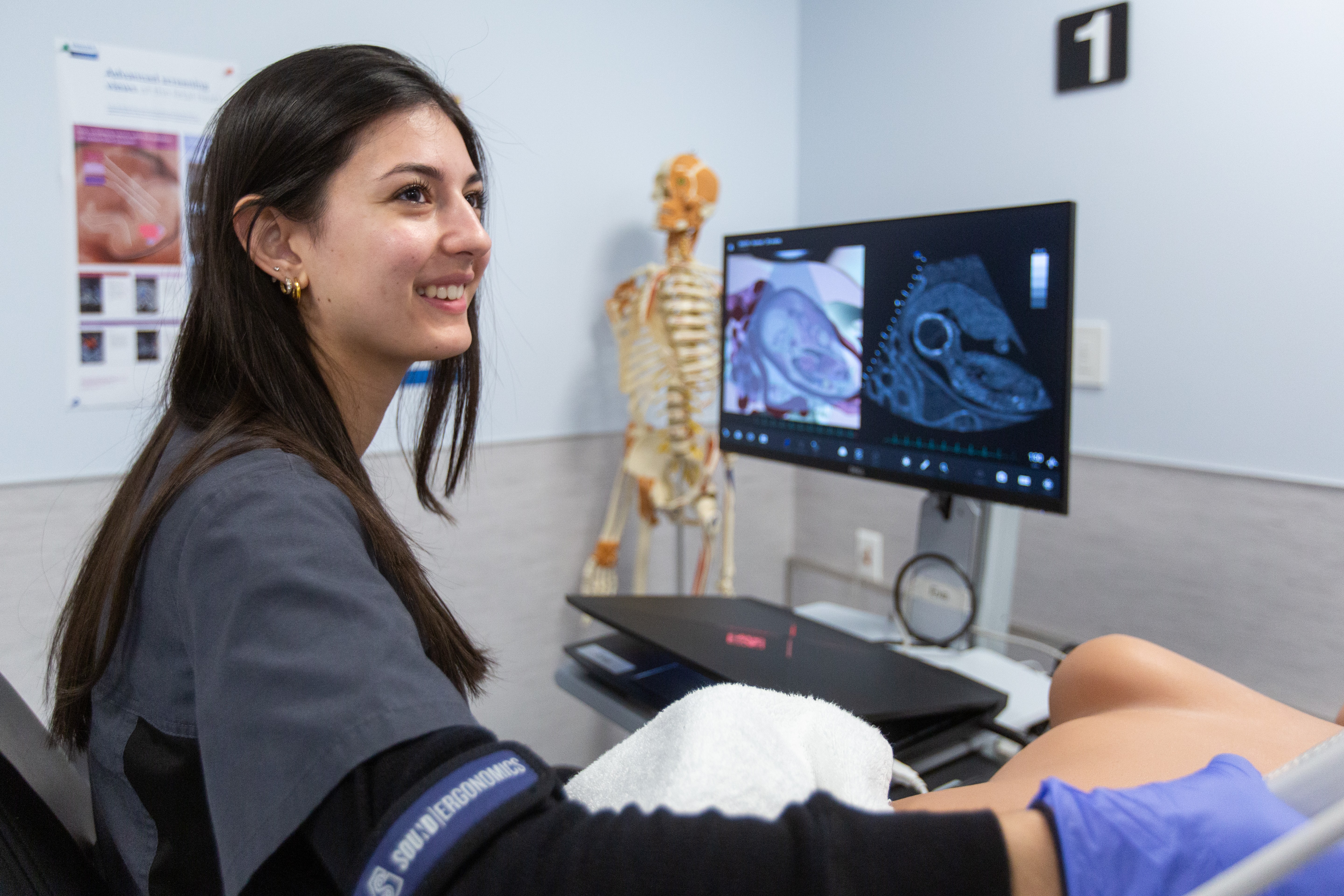
At CNC, we prize our small cohort sizes and supportive faculty and staff. The Sonography Lab at CNC is equipped with a variety of current Ultrasound machines, along with training phantoms and electronic scanning models.
Sonography students are actively learning the hands-on scanning skills of a sonographer from week one in the program. Sonography students begin by practicing scanning on each other in lab, under instructor supervision. And progress eventually to scanning real patients in clinical practicum, under supervision, later in the program.
Sonography students are required to complete the off-campus clinical practicum component of the program, in order to meet the requirements of the Diagnostic Medical Sonography Diploma. Practicum placements in within Prince George are very limited. Students are therefore required to travel, and temporarily relocate, to other cities in British Columbia, Yukon or the North West Territories, to attend practicum sites.
During the final clinical placements, students have the opportunity to demonstrate the required skills from the Sonography Canada National Competency Profile (NCP), by completing the Sonography Canada Canadian Clinical Skills Assessment (CCSA) for the Generalist Sonographer and Cardiac Sonographer.
What you will learn
The accredited 24-month full time program will prepare you to become competent in producing high quality images of multiple body parts and systems including the heart, abdomen, pelvis, blood vessels and obstetrics/Gynecologic.
Training is a combination of classes at the College of New Caledonia’s Prince George campus as well as hands on learning in a variety of hospitals and clinics. The CNC curriculum is mapped to the Sonography Canada National Competency Profile.
Upon successful completion of the CNC Sonography program, you will:
- Perform accurate diagnostic ultrasound examinations in a caring and safe manner, demonstrating cultural competency and awareness
- Display and employ critical thinking and assimilation of theory in the execution of required tasks
- Interact effectively with interdisciplinary team members to attain common health care goals
- Practice sonography in a responsible and ethical manner
- Observe and follow the Sonography Code of ethics and Professional Conduct, as laid out in the Professional Practice Guidelines and Member Policies (evidence 1.1.1), at all times.
The Sonography program is primarily focused on preparing its students to be competent and committed medical professionals, who have a clear understanding of their role within the health professions arena. Guided by the Canadian National Competency Profile for the sonography profession, didactic and laboratory instruction is designed and executed with the sole intention of producing competent and proficient Sonographers. The program is Accredited by EQual Canada.
Program Accreditation and Student Credentials In Sonography
The College of New Caledonia’s Diagnostic Medical Sonography program is accredited by EQual Canada. Accreditation ensures that CNC’s Diagnostic Medical Sonography program curriculum meets the national accreditation standards.
All students who graduate from an accredited Sonography program in Canada are eligible to write the Sonography Canada registry exams in Core (Physics), Generalist, and Adult Echocardiography. Passing the Sonography Canada registry exams provides new sonographers with the credential to practice sonography in Canada.
Graduates from an accredited sonography program in Canada are also eligible to apply to write the American Registry of Diagnostic Medical Sonography (ARDMS) exams to gain their American Sonography credential.
- Learn more about Sonography Program Accreditation
- Learn more about Sonographer Credentials with Sonography Canada
- Learn more about Sonographer Credentials in the USA with ARDMS
Clinical Practicum
Sonography students are required to complete the clinical practicum component of the program, in order to meet the requirements of the Diagnostic Medical Sonography Diploma. Practicum placements in within Prince George are very limited. Students are therefore required to travel, and temporarily relocate, to other cities in British Columbia, and parts of Yukon and the North West Territories, to attend practicum sites.
Note: All costs associated with clinical practicums (relocation, travel, accommodation, etc) are the responsibility of the student.
Recommended Aptitudes and Characteristics
The students who are successful in this program and in the Sonography profession, have or are able to develop the following aptitudes and characteristics:
- Fine motor skills/control and manual dexterity
- Ability to visualize in three dimensions
- Excellent time management and study skills
- Critical thinking and good attention to detail
- Effective communication skills
- The ability to work independently
- Able to work well under stress and in busy work environments
- Willingness to be scanned in lab as a volunteer patient by other sonography students (with instructor supervision)
- Computer literacy and the ability to use and adapt to new technology
- Ability to maintain professional interpersonal behaviour
- Interest in pathology and investigation into clues that help determine a patient diagnosis
- Able to wear Personal Protective Equipment (PPE)
- Can tolerate the sight of needles, human blood and tissue
- Able to meet the physical demands of the Sonographer role* (see details below)
- Comfortable with performing sensitive and close proximity patient care procedures
- Empathy for patients in all types of care situations
Physical Demands of Sonography
Diagnostic Medical Sonographers work predominantly in environments where they spend long periods of time standing or sitting, as well as performing repetitive tasks. Sonographers and students must take care to always observe safety precautions and optimal ergonomics, in order to reduce their risk of exposure or strain and injury.
Physical demands of the Sonographer role include:
- Using your hand, wrist, and arm for prolonged periods
- Assisting in transporting, lifting, and positioning of patients as well as equipment
- Upper body, shoulder and arm strength capable of performing repetitive tasks with the arms and hands
Note: Individuals with previous or existing chronic or repetitive strain injuries have experienced re-injury or aggravation in this program and/or as a practicing sonographer.
Check out the Pre-Program Questionnaire to see if you would be a good fit for CNC’s Diagnostic Medical Sonography program.
Courses
Core Courses
Typical Offerings
| Timing | Fall Only, Every Year |
|---|---|
| Locations | Prince George |
| Requisites |
|
Description
This course introduces students to the sonographic principles of imaging in the normal abdomen and pelvis. The focus is on normal anatomical appearance, variants and common pathologies. Concepts include relational and cross-sectional anatomy and physiology. Students will apply theoretical concepts to scan structures of interest in the abdomen, male pelvis, and non-pregnant female pelvis..Typical Offerings
| Timing | Fall Only, Every Year |
|---|---|
| Locations | Prince George |
| Requisites |
|
Description
This course will introduce students to cardiac anatomy, the cardiac cycle and principles of hemodynamics in cardiac imaging. The focus of this course is on assessment and interpretation of normal cardiac patterns and common arrhythmias. Concepts include the use of windows, modalities, and associated measurements. Students will apply theoretical concepts from this course to simulations in the lab.Typical Offerings
| Timing | Fall Only, Every Year |
|---|---|
| Locations | Prince George |
| Requisites |
|
Description
This course introduces students to the sonographic principles of imaging in the normal abdomen and male pelvis. The focus is on normal anatomical appearance, variants and common pathologies. Concepts include relational and cross-sectional anatomy and physiology. Students will apply theoretical concepts from this course to simulations in the lab.Typical Offerings
| Timing | Fall Only, Every Year |
|---|---|
| Locations | Prince George |
| Requisites |
|
Description
This course introduces students to patient care in sonography. The focus is on the provision of safe, professional care throughout all imaging processes. Concepts include body mechanics and patient transport, communication, care of patient equipment, workplace health and safety and cultural competence. Students will apply theoretical concepts from this course to simulations in the lab.Typical Offerings
| Timing | Fall Only, Every Year |
|---|---|
| Locations | Prince George |
| Requisites |
|
Description
This course introduces students to human relationships relevant to sonography. The focus of this course is on professional communication and interactions with others in the health care setting. Concepts include types, components and intra-organization communication, introduction to neuroscience, memory and learning, and foundational concepts related to typical human behaviours. Theoretical concepts will be practiced in the classroom through role play.Typical Offerings
| Timing | Spring Only, Every Year |
|---|---|
| Locations | Prince George |
| Requisites |
|
Description
This course builds on SONO 100 with a focus on pathology and congenital abnormalities of the abdomen, pelvis and superficial structures. Concepts include relational and cross-sectional anatomy and physiology, as well as differentiation between normal and pathological presentation of structures of interest. Students will apply theoretical concepts from this course to simulations in the lab.Typical Offerings
| Timing | Spring Only, Every Year |
|---|---|
| Locations | Prince George |
| Requisites |
|
Description
This course is a continuation of SONO 103. The focus is the hemodynamics and etiologies related to cardiac disease and corresponding clinical presentation. Emphasis is placed on interpretation and quantification of abnormalities in the adult echocardiogram. Students will apply theoretical concepts from this course to simulations in the lab.Typical Offerings
| Timing | Spring Only, Every Year |
|---|---|
| Locations | Prince George |
| Requisites |
|
Description
This course is a continuation of SONO 105. The focus is on the normal presentation of the female pelvis during pregnancy and the scanning techniques used to thoroughly assess the fetus. Concepts include assessment of the obstetrical patient, the uterine and extra-uterine environments, normal fetal presentation throughout pregnancy, and common complications in the first trimester. Students will apply theoretical concepts to simulations in the lab.Typical Offerings
| Timing | Spring Only, Every Year |
|---|---|
| Locations | Prince George |
| Requisites |
|
Description
This course is a continuation of SONO 109. The focus of this course is on advanced communication skills and atypical personality traits and psychological disorders. Concepts include common communication challenges in health care, conflict resolution, verbal and written presentations and documentation principles. Theoretical concepts will be practiced in the classroom setting through role play and presenting a group case study.Typical Offerings
| Timing | Spring Only, Every Year |
|---|---|
| Locations | Prince George |
| Requisites |
|
Description
This theory course introduces imaging of the carotid arteries and veins of the lower extremities. The focus is on vessel assessment in order to correlate normal sonographic patterns, appearances and values. Concepts include normal anatomy, physiology and venous thrombosis of the lower leg veins. Students will apply theoretical concepts from this course to simulations in the lab.Typical Offerings
| Timing | Intersession Only, Every Year |
|---|---|
| Locations | Prince George |
| Requisites |
|
Description
This course introduces the student to pathophysiology relevant to sonography. The focus of this course is on common pathologies of the abdomen. Concepts include disease terminology, mechanisms of disease, the inflammatory process and common clinical presentations of disease. Content is delivered online and applied in a clinical setting.Typical Offerings
| Timing | Fall Only, Every Year |
|---|---|
| Locations | Prince George |
| Requisites |
|
Description
This course introduces the sonography student to the normal anatomy, physiology and imaging of the abdominal and pelvic cavities and superficial structures. Common pathologies or anatomic variants are introduced. Students will apply theoretical concepts from this course to simulations in the lab.Typical Offerings
| Timing | Fall Only, Every Year |
|---|---|
| Locations | Prince George, Quesnel, Burns Lake, Mackenzie, Vanderhoof |
| Requisites |
|
Description
In this introductory course students will learn the principles of sound travel, interactions within the body, and application to a sonographic exam. Concepts include the properties, creation and detection of sound waves. Also covered are instrumentation, artifacts, digital imaging, and storage and safety considerations for both the operator and the patient. Students will apply theoretical concepts from this course to simulations in the lab.Typical Offerings
| Timing | Spring Only, Every Year |
|---|---|
| Locations | Prince George, Quesnel, Burns Lake, Mackenzie, Vanderhoof |
| Requisites |
|
Description
This lecture course builds on the concepts presented in PHYS 170. The focus of this course is on the principles and instrumentation of Doppler imaging. Concepts include continuous wave, pulsed wave, color, power and tissue Doppler. Students will also learn how to minimize the biological effects of ultrasound. Students will apply theoretical concepts from this course to simulations in the lab.Typical Offerings
| Timing | Fall Only, Every Year |
|---|---|
| Locations | Prince George, Quesnel, Burns Lake, Mackenzie, Vanderhoof |
| Requisites |
|
Description
This theory course is a continuation and integration of PHYS 170 and PHYS 173. The focus is on the relationship between the physical principles of fluid motion and Doppler imaging. Tissue harmonic imaging, contrast imaging, and elasticity imaging in sonography are also covered. Students will learn about the quality assurance and control responsibilities of the sonographer. Students will apply theoretical concepts from this course to simulations in the lab.Typical Offerings
| Timing | Fall Only, Every Year |
|---|---|
| Locations | Prince George |
| Requisites |
|
Description
This course builds on SONO 120 with a focus on more complex pathological conditions of the adult and paediatric abdomen, pelvis, and superficial structures. Concepts include sonographic assessment of the abnormal abdominal wall, associated musculoskeletal and superficial structures, scrotum, thyroid and relevant abdominal Doppler studies. Students will also perform sonographic assessment of the carotids and peripheral vascular system.Typical Offerings
| Timing | Fall Only, Every Year |
|---|---|
| Locations | Prince George |
| Requisites |
|
Description
This course builds on SONO 131. The focus of this course is on the abnormal sonographic findings in carotid arteries and the extremity veins. Concepts include clinical signs and symptoms of vascular disease, abnormal hemodynamics, peripheral arterial Doppler and vascular grafts. Students will apply theoretical concepts from this course to simulations in the lab.Typical Offerings
| Timing | Fall Only, Every Year |
|---|---|
| Locations | Prince George |
| Requisites |
|
Description
This course is a continuation of SONO 123. The focus is on the pathophysiology of cardiac disease and the integration of hemodynamics and clinical findings with sonographic features. Concepts include heart failure, cardiomyopathy, pericardial and pleural disease, cardiac masses, disease of the cardiac vessels and congenital abnormalities and surgical corrections. Students will apply theoretical concepts from this course to simulation in the lab.Typical Offerings
| Timing | Spring Only, Every Year |
|---|---|
| Locations | Prince George |
| Requisites |
|
Description
This course is intended to prepare the sonography student for accreditation with Sonography Canada. Concepts covered include the Canadian Clinical Skills Assessments (CCSA), certification examination process, and how to develop a professional resume and cover letter. This course will be delivered online.Typical Offerings
| Timing | Fall Only, Every Year |
|---|---|
| Locations | Prince George |
| Requisites |
|
Description
This theory course is a continuation of SONO 125. The focus is on complex pathology and pathophysiology of the female (pelvis and all stages of pregnancy) as relevant to sonographic assessment. The emphasis is on performing quality sonographic images, integrating relevant clinical findings and patient history to formulate and communicate a clinical impression. Students will apply theoretical concepts to simulations in the lab.Required Practicum
Typical Offerings
| Timing | Intersession Only, Every Year |
|---|---|
| Locations | Prince George |
| Requisites |
|
Description
This course introduces the student to the clinical environment. The focus of this course is on preparing the student for the transition from theory and laboratory simulations to working in a demanding health care environment. Method of delivery may include lecture, tour of a health care facility, review of health authority general policies/procedures, and other related online activities.Typical Offerings
| Timing | Intersession Only, Every Year |
|---|---|
| Locations | Prince George |
| Requisites |
|
Description
This first clinical experience provides students with the opportunity to integrate theory from term 1 and 2 courses into clinical practice. Students will work in a variety of clinical settings under direct supervision. Learning the role of the sonographer in the context of safe patient care, therapeutic communication, professionalism and collaboration will be emphasized. At the end of this course, students will be able to satisfactorily perform portions of normal and abnormal general and cardiac sonographic assessments with supervision and guidance.Typical Offerings
| Timing | Spring Only, Every Year |
|---|---|
| Locations | Prince George |
| Requisites |
|
Description
This course is a continuation of SONO 135. Students will work in a variety of clinical settings under direct supervision. The focus of this course is on the integration of theoretical knowledge of anatomy, physiology and pathology into sonographic examinations. Students will continue to apply the concepts of safe patient care, therapeutic communication, professionalism and collaboration. At the end of this course, students will be able to satisfactorily perform portions of general and cardiac sonographic assessments on patients with common pathologies with supervision and guidance.Typical Offerings
| Timing | Intersession Only, Every Year |
|---|---|
| Locations | Prince George |
| Requisites |
|
Description
This course is a continuation of SONO 135 and SONO 235. Students will gain further hands on experience on abdominal, pelvis, obstetrical, vascular, superficial and cardiac sonographic imaging in a variety of health care settings. At the end of this course, students will independently perform complete sonographic examinations on patients with common pathologies with minimal assistance. Effective written and verbal communication, creation of safe practice environments, safe patient care and professionalism are emphasized.Typical Offerings
| Timing | Intersession Only, Every Year |
|---|---|
| Locations | Prince George |
| Requisites |
|
Description
This course is a continuation of SONO 245. The consolidation of theoretical knowledge of general and cardiac sonography, application to the clinical setting and competency in skill will be the focus of this course. Upon successful completion of this course, students will be able to independently perform complete patient examinations with consistency and accuracy in all patients. Demonstration of all competencies of entry level practice as described by Sonography Canada in the National Competency Profiles is required.Entry Requirements
Fall 2027 Intake and Onwards
For applications to the Fall 2027 intake (September start), you must meet the following requirements:
- The following courses or their equivalents, with no grade lower than a "B":
- Anatomy and PHysiology 12, or Biology 12, or
- English 12, or English First Peoples 12, or
- Foundations of Math 12, or
- Physics 12, or
English Language Proficiency requirements
Candidates whose first language is not English must meet the English requirements and provide proof of English language proficiency through one of the following:
- Test of English as a Foreign Language (TOEFL iBT) score of 4.5 with no section less than 4.0 or equivalent, within the last two years; OR
- International English Language Testing System- Academic (IELTS Academic) score of 6.5 overall with no band below 6.0, taken within the last two years; OR
- A 3-credit post-secondary-level English, Communications, Creative Writing, or Literature course with a minimum “B-“ grade, taken at a post-secondary institution located on the approved English-speaking country list.
Need help meeting these requirements. Check out our Academic Upgrading options.
Read the Information Package
This program requires an application package as part of the application process. Download the file and submit it with your application.
Selection Process
As there are limited seats available, applicants meeting admission requirements are ranked for acceptance according to their competitive entry selection score.
Maximum points 100
Required documents to be submitted for competitive selection:
- Critical Analysis of Program Readiness Essay
- Proof of BC/Yukon/NWT residence – if applicable
Cumulative grade point average of the required Anatomy and Physiology, English, Mathematics, and Physics courses.
Up to 15 points
| GPA/Grade | Weighting |
|---|---|
| A | 15 points |
| A- | 10 points |
| B+ | 5 points |
| B | 3 points |
Post-secondary education
Up to 20 points
- Successful completion of 60 credits or more at post-secondary with an overall GPA of 2.5 or higher in a health-sciences related program (20 points) OR
- Successful completion of 30 credits or more at post-secondary with an overall GPA of 2.5 or higher in a health-sciences related program (15 points) OR
- Successful completion of 60 credits or more at post-secondary with an overall GPA of 2.5 or higher in a non-health-sciences program (10 points) OR
- Successful completion of 30 credits or more at post-secondary with an overall GPA of 2.5 or higher in a non-health-sciences program (5 points)
Resident of:
Up to 20 points
- BC/Yukon/NWT (10 points) OR
- Northern Health Authority (20 points)
Critical Analysis of Program Readiness Essay
Up to 45 pts
It is important for applicants to the Diagnostic Medical Sonography (DMS) program to have a clear understanding of the admission requirements for this 2 consecutive year educational program, as well as the duties and responsibilities of a Diagnostic Medical Sonographer. In order to gain a thorough understanding of the DMS profession, you should fully investigate this career choice. You may conduct your research of the profession by conversing with people in the profession, attending DMS information activities put on by College of New Caledonia or other institutions, and searching the internet. This research will help you to determine your readiness to enter the DMS program. You will be required to complete a critical analysis of program readiness essay based on the instructions.
Applicants must submit the entry selection documents by the deadline to be included in the competitive entry selection process.
Applicants not offered a seat are placed on a waitlist and will be contacted if a seat comes available.
Self-identified Canadian Aboriginal applicants meeting the admission requirements will be given priority for 20% of seats in the program until the institutionally recognized release date. If there are more qualified Aboriginal applicants than seats at the priority deadline, these qualified applicants will be ranked accordingly.
Program Requirements
Completed program information package must be submitted by the date indicated in the package. Incomplete certifications and documentation will prevent students from entering clinical practice placements. Clinical hours are required for graduation. All certifications must remain valid throughout the program.
- Successful completion of SONO 101: Medical Terminology for Sonography.
- Proof of immunization status as outlined by the BC Centre for Disease Control and as outlined in the Practice Education Guidelines BC Immunization. See Practice Education Guidelines.
- Influenza prevention policy – provincially mandated through the BC Centre for Disease Control. This policy states that anyone working in patient care areas must either be vaccinated yearly or wear a mask for the duration of the influenza season. Information will be provided to students as it becomes available.
- Cardiopulmonary Resuscitation (CPR), Level C, or Basic Life Support (BLS). CPR online courses must include face-to-face practice components.
- FIT tested for a N95 respirator.
- Criminal Record Check (RCMP criminal record checks are not accepted)
Students must complete a provincial Schedule B criminal record search because there is a practicum component involving work with vulnerable people. A search which identifies relevant criminal convictions may prevent students from registering for practicum. To graduate from the Diagnostic Medical Sonography program, each practicum must be successfully completed.
Note 1: All costs associated with certifications, courses and/or documentation requirements are the student’s responsibility.
Note 2: Students will be required to travel across BC for the 39 weeks of practicum, and all expenses related to travel and accommodations are the responsibility of the student.
CNC’s Diagnostic Medical Sonography Program is a highly competitive program that uses a competitive selection process. Successful applicants exceeded entrance requirements. They also have paid or volunteer experience working with people or in the healthcare sector.
The following are recommended to best help prepare applicants for acceptance into this program and also ensure that applicants understand the nature of the Sonography profession:
- Introduction to Ultrasound – The Burwin Institute
- Minimum of 1 year post secondary education (college or university) – especially in human anatomy/physiology, biology and/or health sciences.
- Visit the Sonography Program during CNC’s annual Open House held every March (see CNC’s event page for more information)
- Volunteer to be a patient during our annual Clinical Simulation Clinic, held in early May and early June. Volunteers can meet faculty and current students while participating in a practice clinical experience. Contact sonography@cnc.bc.ca for more information. Or visit the Looking inside yourself page
| Type | Campus | Starts | Status |
|---|---|---|---|
|
|
|
Open for Applications |
Invest in your future
Please check the for up-to-date information.
These costs are an estimate. Student fees vary by campus.
Books for this program can be purchased from the bookstore.
Paying for college
We're here to help. You can apply for scholarships and bursaries through CNC. We can also help you find loans and other funding.
Salaries and employment
Looking for a job? Check the student employment opportunities board.