Associate of Science Biology
| Type | Part Time Full Time |
|---|---|
| Length | 2 years |
| Campus | Prince George |
| Delivery | In Class |
| Fees* |
Check the fee schedule
*All fees are an estimate. |
| Starting Semesters | Fall 2026 Spring 2027 Spring 2026 |
Overview
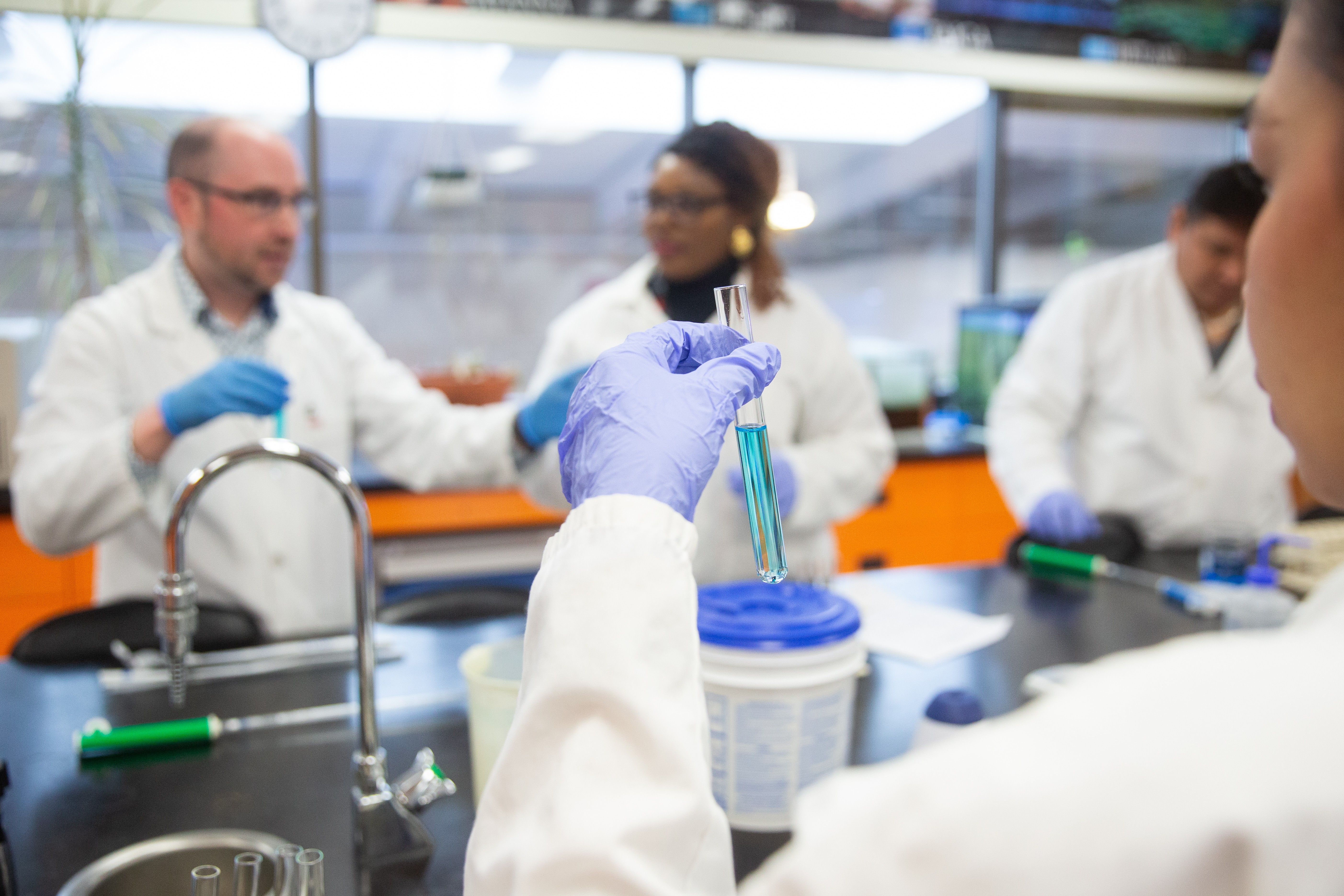
Biology is a rapidly changing field where new discoveries are constantly expanding our understanding of our place in the universe. People with knowledge and skills in biological science are in high demand around the world.CNC offers first- and second-year university-level biology courses that prepare you for careers in biological sciences, education and health care.
Careers
Our biology students can use the Associate of Science with a concentration in Biology as a springboard into a range of cutting-edge and highly regarded fields, including:
- Pharmacy
- Medicine
- Nursing
- Dental hygiene
- Biotechnology
Students can also apply our courses towards the completion of a bachelor’s degree. Associate degrees from CNC transfer into university programs and give you preferential admission at public universities and university-colleges in BC. (Consult the British Columbia Transfer Guide and check with CNC advisors to verify transferability of credits.)
What you will learn
Required and optional/elective courses cover:
- Genetics and DNA
- Ecosystems and ecology
- Cellular biology
- Microbiology
- Biochemistry
- Evolution
This well-rounded program will also cover related disciplines, including chemistry and physics, plus electives in humanities or social science.
Courses
Required courses
Typical Offerings
| Timing | Fall/Spring Only, Every Year |
|---|---|
| Locations | Burns Lake, Mackenzie, Vanderhoof, Prince George, Quesnel |
| Requisites |
|
Description
This course is an introduction to the theory, techniques, and applications of differential calculus. It constitutes the first half of the two-semester first-year calculus sequence for students studying pure or applied science. Together, Math 101 and Math 102 satisfy the first-year mathematics requirement in all university transfer science and applied science programs. Topics include theory of limits, continuous and differentiable functions, algebraic and transcendental functions, basic optimization theory, and applications.Typical Offerings
| Timing | Fall/Spring Only, Every Year |
|---|---|
| Locations | Burns Lake, Mackenzie, Vanderhoof, Prince George, Quesnel |
| Requisites |
|
Description
This course is an introduction to the theory, techniques, and applications of integral calculus. It constitutes the second half of the two-semester first-year calculus sequence for students studying pure or applied science. Together, Math 101 and Math 102 satisfy the first-year mathematics requirement in all university transfer science and applied science programs. Topics include antiderivatives, differential equations, definite and indefinite integrals, techniques of integration, transcendental functions, area, volume, arc length, improper integrals, infinite sequences and series, and applications.Typical Offerings
| Timing | All Terms, Every Year |
|---|---|
| Locations | Prince George, Quesnel |
Description
A study of grammar, composition, and style. A vigorous program of essay-writing plus a variety of writing assignments or exercises dealing with specific problems in essay-writing. Strongly recommended for students who wish to improve their writing skills.Typical Offerings
| Timing | Fall/Spring Only, Every Year |
|---|---|
| Locations | Prince George, Quesnel |
| Requisites |
|
Description
This lecture and lab-based course is an introduction to the biological sciences, with emphasis on the chemical nature of life, cell structure and function, metabolism, DNA replication, gene expression, and ecology. The laboratory component includes experiments that reinforce core concepts from the lecture. This course is intended for science majors.Typical Offerings
| Timing | Spring/Intersession Only, Every Year |
|---|---|
| Locations | Prince George, Quesnel |
| Requisites |
|
Description
An introductory course exploring topics in the mechanism of inheritance at the organismal and molecular levels, evidence for and mechanisms of evolution, ecological relationships, and animal behaviour. The laboratory will include several long-term investigations, including laboratory experiments on organism? environmental relationships and optional field work.Typical Offerings
| Timing | Spring Only, Every Year |
|---|---|
| Locations | Prince George |
| Requisites |
|
Description
The physical and chemical aspects of the biological structure and function of eukaryotic cells is explored, with emphasis on the experimental techniques used to understand cell biology. Additional topics include the evolutionary history of cells and key cell events, such as cell division, cell signalling, cell death, and cell renewal. Laboratory exercises provide an opportunity to perform basic techniques, highlight structures and functions of organelles, and develop skills in experimental design.Typical Offerings
| Timing | Spring Only, Every Year |
|---|---|
| Locations | Prince George |
| Requisites |
|
Description
An introductory biochemistry course focusing on the chemical basis of life. This course emphasizes the biochemistry and function of proteins, DNA, carbohydrates and lipids in living systems. Other topics covered include bioenergetics, properties of enzymes, regulation of enzymatic activity, and current laboratory technology used in the recovery and analysis of DNA and proteins.Typical Offerings
| Timing | Fall Only, Every Year |
|---|---|
| Locations | Prince George |
| Requisites |
|
Description
The course provides an introduction to organic chemistry. A survey of structure and reactivity for the major functional groups is followed by an introduction to analysis and structure determination using nuclear magnetic resonance (NMR) and infrared (IR) spectroscopy. A major topic on chirality and conformational analysis is included. Laboratory experience includes an introduction to synthetic methods.Typical Offerings
| Timing | Spring Only, Every Year |
|---|---|
| Locations | Prince George |
| Requisites |
|
Description
Mechanism and synthesis are discussed as central themes in organic chemistry. This course surveys substitution, addition, elimination, rearrangement, and oxidation reduction reactions for the functional groups introduced in CHEM 203. Additional topics in carbonyl and carbohydrate chemistry are included. Laboratory experiments provide experience in contemporary synthetic methods.Typical Offerings
| Timing | Fall Only, Every Year |
|---|---|
| Locations | Prince George |
| Requisites |
|
Description
This course introduces students to the diversity of the microbial world through a basic taxonomical survey of prokaryotes, eukaryotes, and viruses with emphasis on prokaryotic cell structure, growth & control, metabolism, and genetics. Students will also be introduced to the basic principles involved in the microbiology subdisciplines of microbial ecology, industrial microbiology and medical microbiology. The laboratory component will require proficiency in the basic microbiology laboratory techniques.Typical Offerings
| Timing | Fall Only, Every Year |
|---|---|
| Locations | Prince George |
| Requisites |
|
Description
An introductory course exploring the mechanism of inheritance at the cellular and molecular levels. Topics include the chemical nature of DNA, DNA replication, gene expression, DNA repair, genomics, Mendelian and non-Mendelian genetics. The laboratory will include several long-term investigations, many of which employ the use of the important model organism, Drosophila melanogaster. Experiments include genetic mapping of drosophila genes, population genetics, genome database searches/bioinformatics, and human genome analysis.CHEM 111 or 113
Typical Offerings
| Timing | Fall Only, Every Year |
|---|---|
| Locations | Prince George, Quesnel |
| Requisites |
|
Description
This course is designed for students who have taken a Chemistry 12 equivalent course within the past 2 years. Topics covered include the electronic structure of atoms, trends of the periodic table, modern bonding theories, intermolecular forces and organic chemistry. A strong understanding of stoichiometry is recommended. Students who take this course cannot take CHEM 113 for additional credit.Typical Offerings
| Timing | Fall/Spring Only, Every Year |
|---|---|
| Locations | Prince George, Quesnel |
| Requisites |
|
Description
This course is primarily intended for students without a Chemistry 12 equivalent prerequisite. Topics covered include stoichiometry, solutions, the electronic structure of atoms, trends of the periodic table, modern bonding theories, intermolecular forces and organic chemistry. Students who take this course cannot take CHEM 111 for additional credit.CHEM-112 or 114
Typical Offerings
| Timing | Spring Only, Every Year |
|---|---|
| Locations | Prince George, Quesnel |
| Requisites |
|
Description
Together with CHEM 111, this course provides credit for first-year university chemistry. Topics covered include thermochemistry and chemical thermodynamics, properties of solutions, solution stoichiometry and aqueous equilibria, chemical equilibrium, acid-base equilibrium, electrochemistry and reaction kinetics. Students who take this course cannot take CHEM 114 for additional credit.Typical Offerings
| Timing | Fall/Spring Only, Every Year |
|---|---|
| Locations | Prince George, Quesnel |
| Requisites |
|
Description
This course, together with CHEM 113, provides credit for first-year university chemistry. Topics covered include thermochemistry and chemical thermodynamics, reaction kinetics, properties of solutions, solution stoichiometry and aqueous equilibria, chemical equilibrium, acid-base equilibrium, and electrochemistry. Students who take this course cannot take CHEM 112 for additional credit.PHYS-101 or 105
Typical Offerings
| Timing | Fall Only, Every Year |
|---|---|
| Locations | Prince George, Quesnel |
| Requisites |
|
Description
This course is an algebra-based introduction to physics for students in the life and environmental sciences. Topics include kinematics, dynamics, energy, fluids, geometric optics, temperature, and heat.PHYS-102 or PHYS-106
Typical Offerings
| Timing | Spring Only, Every Year |
|---|---|
| Locations | Prince George, Quesnel |
| Requisites |
|
Description
This course is an algebra-based introduction to physics for students in the life and environmental sciences. Topics include momentum, rotational motion and dynamics, Newtonian gravitation, rotational equilibrium, vibration and waves, wave optics, electricity, and magnetism. This course, along with PHYS 105, satisfies physics requirement for those whose program areas require a year of university-level (non-calculus) physics.ENGL choice
Humanities or Social Science
Elective Arts, Sciences that transfer to SFU UBC UNBC UVIC
Entry Requirements
Spring 2027 Intake and Onwards
For applications to the Spring 2027 intake (January start), you must meet the following requirements:
Program Specific Recommendations
To allow for greater course selection it is recommended that students have the following high school subject in addition to the admission requirements:
- Anatomy & Physiology 12, or
- Chemistry 11, or
- Foundations of Math 11, or
- Physics 11, or
We suggest that you consult with an Academic Advisor or the BC Transfer Guide when planning your Associate Degree to confirm the courses you take will satisfy the lower-level degree requirements at the University you plan to continue to.
Need help meeting these requirements? Check out our options.
Open admission
Any program of study that does not have a selective admission process or fixed capacity and is on a “first qualified, first admitted” basis.
| Type | Campus | Starts | Status |
|---|---|---|---|
|
|
|
Open for Applications |
|
|
|
Open for Applications |
|
|
|
Open for Applications |
Invest in your future
Please check the fee schedule for up-to-date information.
These costs are an estimate and do not include books. Costs may change without notice. Student fees vary by campus.
Books for this program can be purchased from the bookstore.
Paying for college
We're here to help. You can apply for scholarships and bursaries through CNC. We can also help you find loans and other funding.
Salaries and employment
Looking for a job? Check the student employment opportunities.