Nursing Baccalaureate
| Type | Part Time Full Time |
|---|---|
| Length | 2 years |
| Campus | Prince George Quesnel |
| Delivery | In Class |
| Fees* |
Check fee schedule
International Check fee schedule
*All fees are an estimate. |
| Starting Semesters | Fall 2026 |
Fall 2026 Applications Closed for Quesnel
Applications for the 2027 Fall Intake open on October 1st, 2026.
Overview
Become a Registered Nurse by enrolling in the Northern Collaborative Baccalaureate Nursing Program (NCBNP). This program is offered in collaboration with partner institutions. The NCBNP is a four-year degree program that consists of 136 credits with 95 required credits in nursing.
The program is available at three sites: Prince George, Quesnel and Terrace.
Years 1 and 2:
College of New Caledonia (CNC) Prince George
College of New Caledonia (CNC) Quesnel
Coast Mountain College (CMNT) Terrace
Years 3 and 4:
University of Northern BC (UNBC) Prince George
University of Northern BC (UNBC) Quesnel
University of Northern BC (UNBC) Terrace
Upon completion of this program, you will receive a Bachelor of Science in Nursing (BScN) degree granted by UNBC. Graduates qualify to write the National Council Licensure Exam (NCLEX-RN) and to register with the British Columbia College of Nurses & Midwives (BCCNM).
Careers
Upon completion of this program, you will be prepared for employment as a Registered Nurse in a number of work environments:
- Medical Clinics
- Hospitals (various acute care settings)
- Vaccine Clinics
- Long Term Care Facilities
- Mental Health Facilities
- Public & Community Health
What you will learn
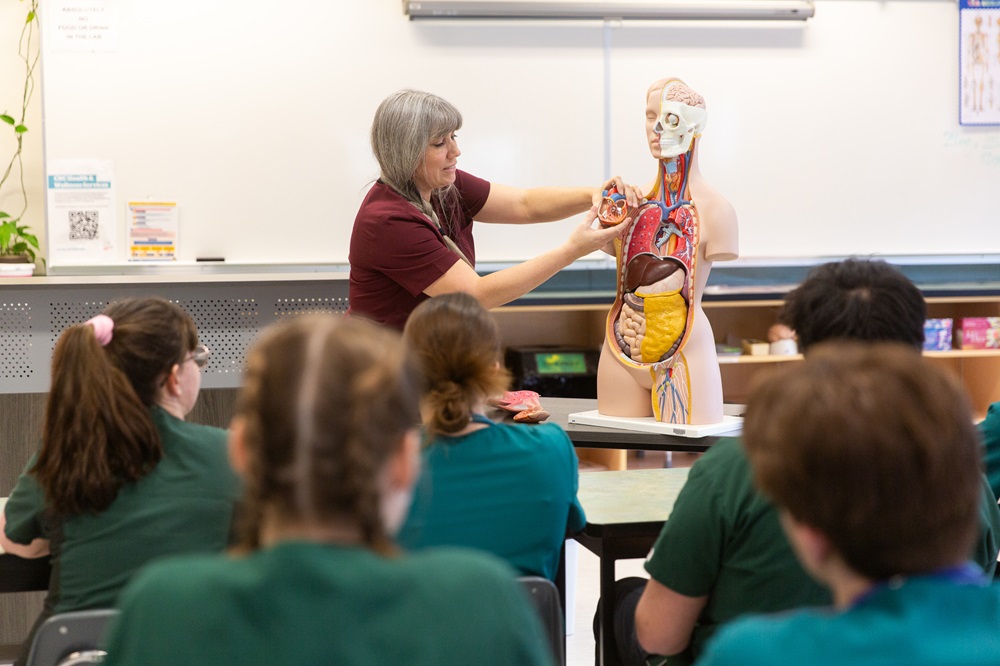
The NCBNP is a practice-based curriculum. Learning experiences take place in the classroom, community, laboratory, and in clinical settings promoting integration of theoretical knowledge into practice. Students will have the opportunity to learn from expert practitioners.
Courses
Required Courses
Typical Offerings
| Timing | Fall/Spring Only, Every Year |
|---|---|
| Locations | Prince George, Quesnel |
| Requisites |
|
Description
This course introduces the student to the dimensions of professional nursing practice. Through group and individual learning activities, student are introduced to professional nursing practices and concepts, issues and trends in both nursing and the Canadian health care system. Students are introduced to foundational nursing skills in the laboratory. Students are provided the opportunity to apply foundational nursing skills in the clinical setting with adults.Typical Offerings
| Timing | Fall Only, Every Year |
|---|---|
| Locations | Prince George, Quesnel |
| Requisites |
|
Description
This course provides a foundation for therapeutic communication in nursing practice. Communication skills are fundamental in any relationship to facilitate the health and well-being of clients. Students have the opportunity to increase self-awareness and explore perceptions, attitudes, and values via a variety of communication methods applied to multicultural and multi-generational cohorts. Students are given the opportunity to practice foundational communication skills in the laboratory settingTypical Offerings
| Timing | All Terms, Every Year |
|---|---|
| Locations | Prince George, Quesnel |
| Requisites |
|
Description
The basic principles of microbiology are presented in this course, with an emphasis on the relevance of these principles to human health. This course deals with studies of the morphology, growth, and modes of transmission of microorganisms. Topics will also include asepsis, immunology, chemotherapeutic drugs, and epidemiology of infectious diseases.Typical Offerings
| Timing | All Terms, Every Year |
|---|---|
| Locations | Prince George, Quesnel |
| Requisites |
|
Description
This course is the first half of a comprehensive survey of the structures and functions of the human organ systems. Lecture topics include cellular physiology, histology, and studies of the integumentary, skeletal, nervous, and endocrine systems. An extensive laboratory component is included. This course is appropriate for students who intend to enter Health Sciences programs.Typical Offerings
| Timing | All Terms, Every Year |
|---|---|
| Locations | Prince George, Quesnel |
| Requisites |
|
Description
This course is a continuation of Human Anatomy and Physiology I. It is designed to cover the anatomy and physiology of the muscular, cardiovascular, lymphatic, respiratory, digestive, urinary, and reproductive systems. The emphasis is on the importance of homeostasis and how it is maintained by the concerted functioning of body systems. A laboratory component is included.Typical Offerings
| Timing | Fall Only, Every Year |
|---|---|
| Locations | Prince George, Quesnel |
| Requisites |
|
Description
The course provides the basis to gather a health history and to assess the functioning of individuals through the proper use of physical examination techniques. Psychosocial and cultural assessment is included. The emphasis is on recognition and identification of normal findings.Typical Offerings
| Timing | Fall Only, Every Year |
|---|---|
| Locations | Prince George, Quesnel |
| Requisites |
|
Description
This course uses a conceptual approach to examine pathological mechanisms of altered states in human physiology. Topics include the etiology, cellular metabolism, tissue alterations, functional changes, and agerelated differences involved in each process.Typical Offerings
| Timing | Fall/Spring Only, Every Year |
|---|---|
| Locations | Prince George, Quesnel |
| Requisites |
|
Description
Introduces theory related to diverse families across the lifespan within the context of primary health care in Northern populations. Emphasis is on family assessment skills and working in partnership with families in the development of health promotion and illness and injury prevention strategies. Holistic care of diverse families during transitions such as normal childbearing, childrearing, and caring to an elderly parent is included.Typical Offerings
| Timing | Fall Only, Every Year |
|---|---|
| Locations | Prince George, Quesnel |
| Requisites |
|
Description
Provides an overview of healing modalities currently used by nurses and other experts in practice in British Columbia. Principles of pharmacology and pharmacodynamics are addressed. Opportunity is provided for students to explore various complementary healing techniques.Typical Offerings
| Timing | Fall/Spring Only, Every Year |
|---|---|
| Locations | Prince George, Quesnel |
| Requisites |
|
Description
Provides an overview of First Nations health, factors influencing health status, and issues arising from Northern and remote living. Historical events and their impact on health are introduced. Current barriers to health, along with culturally sensitive nursing implications, are explored.Typical Offerings
| Timing | All Terms, Every Year |
|---|---|
| Locations | Prince George, Quesnel |
| Requisites |
|
Description
This course reviewsthe physiology of macronutrients, fluids and electrolytes; and energy metabolism. It examines the nutritional needs of specific client groups throughout the lifespan and in various states of wellness and disease. It examines trends and issues in nutritional practice in society, and the nutrition care process in the healthcare setting.Typical Offerings
| Timing | Spring Only, Every Year |
|---|---|
| Locations | Prince George, Quesnel |
| Requisites |
|
Description
This course examines principles and practices of nursing adults with health problems. The focus is on the acquisition and application of knowledge in planning, implementing and evaluating the nursing care of clients requiring medical and surgical intervention. Holistic health care of individuals is highlighted. The course includes laboratory instruction in psychomotor skills. The clinical practicum enables the student to integrate the theory and skills needed to provide nursing care.Typical Offerings
| Timing | Intersession Only, Every Year |
|---|---|
| Locations | Prince George, Quesnel |
| Requisites |
|
Description
This practicum provides the opportunity for consolidated clinical nursing practice with adults who have health problems. This course builds on previous clinical practice with the adult and occurs in various settings in northern BC.Non-nurse required
Typical Offerings
| Timing | All Terms, Every Year |
|---|---|
| Locations | Prince George, Quesnel, Vanderhoof, Burns Lake, Mackenzie |
| Requisites |
|
Description
Cultural anthropologists examine social patterns and practices across cultures, with a special interest in how people live in particular places and create meaning. The goal of this course is to examine the diversity of existing human cultures as well as provide students with a basic understanding of the fundamental concepts used by cultural anthropologists. Topics include research methods, economic systems, marriage, kinship, political systems, expressive culture, religion, illness, and gender. Examples will be drawn from a variety of Indigenous cultures.Typical Offerings
| Timing | All Terms, Every Year |
|---|---|
| Locations | Burns Lake, Mackenzie, Vanderhoof, Prince George, Quesnel |
Description
This general survey course includes topics such as a brief history of psychology, basic research methodology, biological psychology, sensation, perception, consciousness, learning, memory, language and thought.Statistics required
Typical Offerings
| Timing | All Terms, Every Year |
|---|---|
| Locations | Prince George, Quesnel |
| Requisites |
|
Description
This course is an introduction to the theory, techniques and applications of elementary statistics and statistical methodology. It is intended primarily for students majoring in health sciences, business, and liberal arts programs. Topics include descriptive statistics, sampling, elementary probability, probability distributions, statistical inference, correlation, linear regression and analysis of variance. Applications to a wide variety of real-world problems are emphasized.Typical Offerings
| Timing | All Terms, Every Year |
|---|---|
| Locations | Prince George, Quesnel |
| Requisites |
|
Description
This course introduces the student to basic statistical methods. Topics include descriptive statistics, probability, estimation, hypothesis testing, charting, and linear regression. Applications to business are stressed.Entry Requirements
Entry Requirements
Applicants must:
- UNBC admission requirements with a minimum 70% average; and
- Completion of the equivalent of the BC secondary school courses with a minimum 70% in each course:
- One of Foundations of Mathematics 11 or Pre-Calculus 11 or Principles of Math 11 or
- Chemistry 11 or
- One of English Studies 12, English 12 or English First Peoples 12 or
- Completion of the equivalent of Anatomy and Physiology 12 or Biology 12 with a minimum 73% within five years prior to the semester of admission to the NCBNP.
- Please see UNBC nursing admission requirements there may be more academic courses needed.
Applicants whose first language is not English, regardless of citizenship or country of origin, must submit evidence of English language proficiency prior to admission. For the NCBNP, the following are required for admission:
- Fulfillment of the BC Secondary School English 12 requirements (70%), or equivalent, and
- Either an IELTS (International English Language Testing System) Academic or a CELBAN (Canadian English Language Assessment for Nurses) with current, valid results and scores as set by British Columbia College of Nurses and Midwives (BCCNM) for the year of admission.
Licensed Practical Nurse (LPN) access
Licensed Practical Nurses (LPNs) who are applying for admission to the NCBNP must:
- Meet all Northern Collaborative Baccalaureate Nursing Program admission requirements
- Be a graduate of a Practical Nursing program recognized by the British Columbia College of Nurses and Midwives (BCCNM) since 1994
- Have current practicing or be eligible for practicing registration with the BCCNM
LPN applicants will be assessed on an individual basis and may be eligible for up to a maximum of 15 transfer credit hours of Nursing courses.
Applicants who have completed a BC Practical Nursing Certificate prior to 1994, or have completed a certificate or diploma from a program outside of British Columbia, or have graduated from an institution not listed in the BC Transfer Guide, may not be exempt from any of the Year 1 or Year 2 nursing courses.
All successful LPN applicants must meet individually with the Nursing Advisor at the institution to which they are applying in order to have their documents referred to Nursing Faculty for transfer credit assessment. Further criteria may be required in order to receive transfer credit.
Need help meeting these requirements? Check out our options.
Immunization and CPR Certification
All students accepted into the NCBNP are sent documentation and information regarding immunization policies. Once accepted into the Program, all students must submit the following:
- A record of immunization status and any annual vaccination requirements, such as Influenza, based on release date of vaccine.
- A completed immunization form must be submitted to the institution the student is currently attending prior to Sept 15 in the first year of attendance. Students entering the Program in Year 2 or above must submit the completed immunization form before the first week of classes in September. Failure to do so may result in the student not being allowed to practice in the clinical setting.
- Documentation of one of the following CPR certifications, which must be successfully maintained throughout the program: CPR-C or Basic Life Support (BLS). BLS is highly recommended. Online CPR courses that do not include face-to-face practice components are not acceptable;
- Proof of CPR certification (and recertification, as needed) must be submitted annually prior to commencement of classes;
- Annual recertification of CPR is required regardless of expiry date on the card.
| Type | Campus | Starts | Status |
|---|---|---|---|
|
|
|
Open for Applications |
|
|
|
Applications Closed |
Invest in your future
Please check the for up-to-date information.
These costs are an estimate and do not include books. Costs may change without notice. Student fees vary by campus. Books for this program can be purchased from the bookstore.
Additional costs for this program (nursing kits): $300
Paying for college
We're here to help. You can apply for scholarships and bursaries through CNC. We can also help you find loans and other funding.
Salaries and employment
Looking for a job? Check the student employment opportunities.